Monday, March 28, 2022

Detachment Disorder

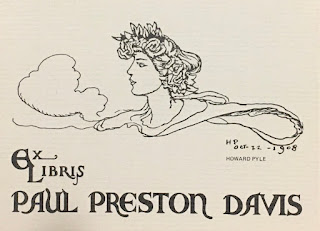
Howard Pyle’s bookplate on the marbled pastedown endpaper of…what, exactly?

We may never know, because someone - a monster - conveniently detached the cover from the rest of the book. (Please don’t follow this example: it’s like cutting the signature off a letter then throwing the letter away.) I suspect, though, that it came from a uniform set of one of Pyle’s favorite authors - Jane Austen? Eugene Field? Robert Louis Stevenson? - as there are at least two other detached, half-morocco, marbled boards just like this one.

When Pyle made his own bookplate is, as yet, hazy. On January 9, 1902, he wrote: “I would be very glad to send you a bookplate if I had one but, upon the same principle that a shoemaker’s children go barefoot, my not invaluable library has, for all these years, gone without such accompanying decoration.”

For years Pyle had pasted a small paper label, featuring only his name engraved in script, into his books, but sometime after January 1902 he settled on this more elaborate design, which he painted - and hoped to reproduce - in full color. But the color version was unsatisfactory, so Pyle had a photogravure plate made instead, and had the bookplate printed in sepia.

Pyle’s Latin motto - ITA PRIMO, ITA SEMPER - was one he had used before, on THE WONDER CLOCK title-page, the frontispiece of TWILIGHT LAND, and perhaps elsewhere. Roughly translated, it means, “Thus first, thus always,” or “As it was in the beginning, so it will ever be.”

The original painting, by the way, now belongs to The Brandywine River Museum.

Monday, March 14, 2022

A Witness to History (Sort of)

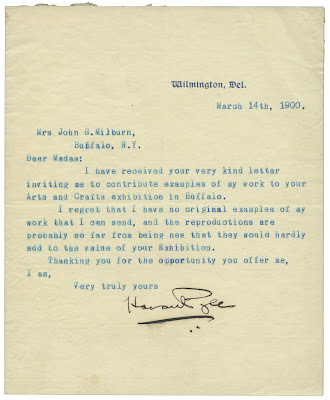
Although not particularly substantive, this Howard Pyle letter - written 122 years ago today - to Mrs. John G. Milburn of Buffalo, New York, is of interest by association.

Mrs. John G. Milburn’s husband was President of the Pan-American Exposition Company and the Milburns lent a suite of rooms in their house at 1168 Delaware Avenue to President and Mrs. William McKinley to use during their visit to the Exposition in 1901.

After spending two nights with the Milburns, on the afternoon of September 6, 1901, the President was shot pointblank in the abdomen by Leon Czolgosz at the Exposition’s Temple of Music.

Following an operation at the Exposition hospital, McKinley was taken by ambulance to the Milburn house. There, Abraham Lincoln’s son Robert and Vice President Theodore Roosevelt (among dozens of others, apparently) came to visit while McKinley convalesced. And it was there, on September 14, 1901, exactly 18 months to the day after Pyle wrote his letter - which must have been somewhere on the premises - President McKinley succumbed to his wounds.

Tuesday, February 15, 2022

Paul Preston Davis (1931-2021)

“‘We note the passage of our life by its losses and neglects,’ says a certain author,” Howard Pyle once wrote. I have yet to identify who that “certain author” was, but the quote has come to mind often since my last post - and especially since March 18, 2021, when we lost one of Pyle’s greatest champions, Paul Preston Davis.

I’d felt Preston’s loss since May 2020, in fact, when he called to tell me he was terminally ill. I meant to write him soon after, but I couldn’t find the words, and the next time we spoke - for over two hours, all about the weathervane on Pyle’s studio - he sounded so “normal” that I foolishly thought he’d gotten better, somehow.

In one of my old journals there’s an entry about a visit I made with my mother to Wilmington thirty years ago today, on February 15, 1992:
Saturday was grey and the Book Fair at the DuPont Country Club was not abundant, but I was successful in that I met Paul Preston Davis who told me to come over after the show - so Mom and I did follow him home through the rain and stayed 3 hours, me talking nonstop and poring over his dogeared but massive Pyle collection. It was a wonderful thing, as he is a man after my own heart and mind when it comes to Pyle. It was overwhelming, amazing, dizzying, and I left grinning.
I also left with a big box of Preston’s duplicates and a promise to pay him back at some point. But after receiving a portrait of Pyle I’d painted as a thank you, he forgave the debt. (That’s also when he inadvertently became a completist collector of my work - whether he really wanted to or not.)

Around the same time Preston and I met, we both realized that, despite being longtime collectors of Pyle’s work, we knew comparatively little about Pyle’s life. So we set about tracking down information in earnest: he in the Greater Wilmington area; me in and around New York and writing - longhand - to libraries across the country that might hold even just one Pyle letter. There was much more out there than we’d expected, and every few weeks we’d debrief each other and exchange copies of what we’d turned up. The tiniest factoid often led us to whole new areas of research which spurred us to ferret out still more and more.

Of course, all that ferreting applied to our respective Pyle collections, too, so our friendship sometimes had - for me, at least - a competitive, covetous edge to it. Preston was a quiet, methodical, doggedly determined collector of the “Hoovering” school - sucking up anything and everything - and he had the advantage of living in “Pyle Country” and having myriad local connections. It was maddening. I still kick myself over things I “lost” to him: Pepper and Salt in a dust jacket! That photo of Pyle with a full head of hair! Yet he never crowed over his acquisitions and was always congratulatory when I found something special or interesting. Eventually - mercifully - we reached a point of “Well, if I can’t have it, at least it found a home with you.”

Over the years I must have logged more telephone time with Preston than anyone else in my life, including my own family: I was always happy to talk about new leads, new finds, new treasures, or to pick up threads of years-old conversations. And when he asked for help on his huge Pyle bibliography, I gladly spent several four- and five-day stretches holed up in his library, collating, cross-referencing, and double-checking details. During other visits we ventured outside: digging at the Delaware Archives and the Delaware Art Museum, and driving in around Wilmington and Chadds Ford, in search of remnants, ruins, or at least locations of Pyle’s haunts and homes. Those long, meditative hours with him are among my favorite memories.

And yet, for all our time together - on the phone, in letters, or in person - Preston and I rarely spoke of things other than Pyle, and I’m embarrassed to admit that I knew little about the rest of his life, except for snippets picked up here and there. But the pursuit of all things Pyle has always been a respite from the outside world for me, and I think it was for Preston, too.

I still can’t find all the words to say how important he was to my life - and to Howard Pyle’s memory - but maybe these will do for now.

**********

More about Paul Preston Davis’s Pyle collection - which now resides at the Brandywine River Museum - can be found here. And this video highlights his collection of Delawareana, now at the Delaware Historical Society.

Saturday, November 9, 2019

“I have made a very great mistake”

“I have just received the complimentary copies of my last book, ‘Sir Launcelot and His Companions,’” wrote Howard Pyle to Charles Scribner’s Sons on October 26, 1907.

Like many authors and illustrators, Pyle may have leafed through the new volume with a mixture of pride and apprehension. And in this case an embarrassing discovery was in store: “I notice in looking it over that I have made a very great mistake, for the picture on page 200 entitled ‘Sir Gawaine of the Fountain’ should read ‘Sir Ewaine of the Fountain.’”

Ever careful Pyle had not been careful enough. As with most of his children’s books, he had delivered Sir Launcelot and His Companions in fits and starts while juggling other work. To safeguard against errors and inconsistencies, on mailing one batch he had asked the publisher “to send me proofs of these drawings as soon as they are reproduced, for I shall maybe use the same characters in later decorations.”

And yet, although the picture served as a frontispiece to Part V of the book titled “The Story of Sir Ewaine and the Lady of the Fountain,” and three other illustrations of which featured Sir Ewaine, “Sir Gawaine” had slipped past Pyle - not to mention everyone else involved with the production of the book.

“Perhaps before any more copies are printed you will have this changed in New York (where almost anyone could do the lettering) or else send it to me to have the lettering changed,” Pyle continued in his letter of October 26. “It is very curious that this mistake should have happened but, as I say, it is altogether my fault.”

The expense of correcting the plate, however, must have been too much for Scribner’s to consider, and Pyle must have forgotten all about it, because the mis-titled illustration has lived on, reprint after reprint, and has never been called out or corrected.

But as I am “almost anyone [who] could do the lettering” (as well as being in New York), I’ve belatedly honored Pyle’s request, below.


Sunday, July 29, 2018

He looked down and sang out, “Lower away!”

Howard Pyle’s painting “He looked down and sang out, ‘Lower away!’” has never gotten much attention.

There are two chief reasons for this: the first is that it was printed only once, in Scribner’s Magazine for January 1900, where it and two other pictures - one of which was featured here - accompanied Pyle’s short story, “A Life for a Life.”

The tale was inspired by the effects of the Blizzard of 1888 on the ships in and around the Breakwater at Lewes, Delaware. A day or two after the storm, Pyle made the 90-mile trip “down the bay” to look things over and interview several survivors. The result was the article “The Great Snow Storm in Lewes Harbor” in Harper’s Weekly for March 31, 1888. But the eye-witness accounts lingered with Pyle, and some ten years later he wrote a “A Life for a Life,” which Scribner’s Magazine accepted for publication probably sometime in late 1898.

By early January 1899, Pyle had finished his story’s three black and white oil illustrations (each about 18 x 12 inches). But he had misgivings about “Lower away!” almost as soon as he had shipped it: on January 10th, he wrote to art editor Joe Chapin that while the other two could stand as they were, “The picture of the man being lowered out of the shrouds, however, does not seem to me to be so satisfactory. I do not feel the blowing of the wind and the figures strike me as being too much like models posing.”

The painting was returned to Wilmington, but it wasn’t until June 13, 1899, that ever-busy Pyle told Chapin, “I am sending you today the drawing for ‘A Life for a Life’ which I have, I trust, improved by making the storm a little more realistic and powerful.” It’s not clear if Pyle altered the figures, after all, or if enlivening the background had remedied their “posed” look.

Charles Scribner’s Sons paid Pyle $300 outright for the three paintings, which were subsequently exhibited in a travelling show of illustrations made for the firm. And in 1915 two of the three - as well as scores of other Pyle originals - were sold to the Wilmington Society of the Fine Arts. But “Lower away!” was not among them. And here is the second reason why it’s gotten so little attention: born out of one disaster, “Lower away!” (like Pyle’s set of pictures for The Story of Siegfried) succumbed to another: the Scribner building fire of July 29, 1908.

Sunday, November 5, 2017

A Pyle Inscription

Howard Pyle sometimes drew a little picture when he signed his books, like in this copy of the 1901 edition of The Wonder Clock which he inscribed on November 5, 1901.

Saturday, June 24, 2017

The Story of Siegfried


“The Forging of Balmung” by Howard Pyle (Frank French, engraver)

“Please let me know when you are likely to be in New York again,” wrote E. L. Burlingame, editor at Charles Scribner’s Sons, to Howard Pyle on January 12, 1882. “We have a matter of some importance which I think would interest you; at all events I should like to talk it over with you at your first opportunity.”

The “matter” was the illustrations for James Baldwin’s retelling of the Siegfried (or Sigurd) legends. At the time, Pyle - whose interest in Medieval folklore was already well-established - was under an exclusive, one-year contract with Harper & Brothers for his pictures, but as it only extended to periodicals and not to books, he was able to accept the commission.


“The Death of Fafnir” by Howard Pyle (John Parker Davis, engraver)

Four and a half months later, on May 26, 1882, Burlingame updated Baldwin on the book’s progress:
Up to this time the manuscript has been in the hands of the artist, Mr. Howard Pyle, who has been somewhat delayed in making drawings.... The illustrations are now well advanced, however; they are six in number, full-page cuts, and are in our opinion admirably conceived and drawn. Proofs of them will be sent you as they are received from the engravers.
It’s not clear if “the illustrations” referred to Pyle’s black and white gouache paintings or to the wood-engravings thereof, but Pyle definitely delivered his work before June 8, when Burlingame again wrote to Baldwin:
We send you by this post some very rough unmounted photographs of Mr. Howard Pyle’s drawings for Siegfried. These will give you no idea, to be sure, of the great beauty and force of the pictures themselves; but they only convey the grouping and general composition well enough to show you that we have given the work to one of the best artists for such a subject. Mr. Pyle has been cordially interested in it, and in our opinion has done his part in the true spirit of the text.


The Story of Siegfried (New York: Charles Scribner’s Sons, 1882)

Handsomely bound, with cover art adapted from Pyle’s “The Forging of Balmung,” The Story of Siegfried was published in October 1882. The illustrations were roundly praised: the Detroit Free Press said that they “deserve special mention for their beauty and fidelity. Nothing better in book illustration has been done this season.” “The interest in the legends will be much enhanced in young eyes by the striking pictures furnished by Howard Pyle,” observed The San Francisco Chronicle, and The Daily Union-Leader of Wilkes-Barre noted that the book “is happily illustrated by Pyle, whose drawings, it is safe to say, have never been surpassed for such a purpose.” And Pyle’s hometown paper Every Evening remarked:
The dear, delightful people of the Nibelungen come before one bodily, and in such a way that one feels thankful to the artist for his creation of them. The illustrations are full of ideality, and without that apparent assumption of oddness that has, in the eyes of some, spoiled Mr. Pyle’s good work. The awakening Brunhild by the kiss of Siegfried, is exquisite. The calm, placid expression of her face, and the wonder that overspreads the knight’s, display a real feeling with the legend, and without which feeling no man should illustrate a book.


“The Awakening of Brunhild” by Howard Pyle (E. Clément, engraver)

What Pyle himself thought of the illustrations is not known, but “The Death of Siegfried” (below) is surely one of the best and most “Pylean” things he made thus far in his 6-year-old career.

In 1885, four of the set were included in the Grolier Club’s Exhibition of Original Designs for Book Illustration, but afterward they - like most of Pyle’s Scribner work - joined the other two at the publisher’s offices on Broadway near Astor Place, and then to Fifth Avenue between 20th and 21st Streets, where Charles Scribner’s Sons relocated in 1894.


“The Trial of Strength” by Howard Pyle (John Karst, engraver)

Over the years, some of Pyle’s originals found their way out of storage - sold or given away piecemeal - but most remained there until 1915, when The Wilmington Society of the Fine Arts acquired some 68 of them - almost all that were left. The six Siegfried illustrations, however, were not included. Why?


“The Quarrel of the Queens” by Howard Pyle (John Karst, engraver)

On July 29, 1908, the New York World reported:
BLAZE IN SCRIBNER’S
—————
Fire Starts in Counting Room and Does $6,000 Damage.

A fire originating on the third floor of Scribner Bros.’ publishing house, Nos. 153, 155 and 157 Fifth avenue, at 5 o’clock this morning caused damage amounting to $6,000. Patrolman Jones saw the reflection of the flames and turned in an alarm.
The firemen broke into the building and found the blaze had gained headway in the counting room on the third floor and worked through to the fourth floor. The origin of the fire is a mystery.
The extent of the “$6,000 damage” is also a mystery, but Scribner’s index-card inventory of artwork (now at the Brandywine River Museum) shows that all six Siegfried pictures and at least one other Pyle oil - not to mention works by his fellow artists, like N. C. Wyeth - were destroyed.


“The Death of Siegfried” by Howard Pyle (E. Clément, engraver)

Tuesday, February 14, 2017

Love Will Tear Us Apart

It was in 1880, most likely, that 27-year-old Howard Pyle - then living and working at his parents’ house, but soon to be married - painted “St. Valentine’s Day in the Morning”. The black-and-white gouache measured about 18 x 15 inches or so, but the picture as engraved by Gustav Kruell was only 12.7 x 9 inches when it appeared in the February 26, 1881, issue of Harper’s Weekly.

As far as early Pyles go, the postman, the costuming, and the setting are as strong as usual - even then he was a master at depicting overcast days and the tangle of distant trees. But I confess that I don’t love the woman.

Helen “Teri” Card (1903-1971) - the comparatively early champion and dealer of illustration art - didn’t love her, either. And sometime before issuing her landmark, pulse-quickening “Catalog #4” of Pyleana in the early 1960s, Card tore off the offending half of Pyle’s original and tossed it. I wouldn’t have gone that far: the woman’s coy expression doesn’t feel right, but the rest of her is rendered nicely enough.

Card sold the surviving “better half” (see below) for $90 to collector Clifton Waller Barrett, and it now lives at the Brandywine River Museum.

Tuesday, October 18, 2016

“This is the last week at the Ford...”

“This is the last week at the Ford and I’ll make the best of it,” wrote N. C. Wyeth to his mother on Sunday, October 18, 1903. “Then back to Wilmington where I hope before I leave again I’ll be doing illustrating galore.”

It was indeed the last week at Chadd’s Ford: after six years, never again would Howard Pyle conduct his “Summer School” there. That very morning he had held his final composition lecture - “an exceptionally fine” one, noted Wyeth, “although my comp. wasn’t up to snuff.”

“Today a friend of Randolphs was out and had a camera,” Wyeth also wrote, referring to the Randolph family of the “Wyndtryst” estate nearby. “He wanted a picture of Mr. Pyle but Mr. Pyle would not be taken alone so took Palmer and I, putting his arms around both of us.”

The result - almost certainly - was the snapshot shown here, although it includes a couple more people than Wyeth mentioned. From left to right are Samuel Morrow Palmer Jr. (28), N. C. Wyeth (about to turn 21), Howard Pyle (50), Allen Tupper True (22), and James Edwin McBurney (34). (Palmer and McBurney, by the way, had studied with Pyle at the Drexel Institute and in 1900 or 1901 Pyle had invited them both to join his newly-formed school of art in Wilmington.)

The five are standing outside Lafayette Hall, where the Pyles lived when summering at “the Ford”. And although it had rained all Saturday and the sky still looks gray in the photograph, on Sunday the weather had cleared, and - as True said in a letter to his mother - sometime after the lecture, or the photo, or both, “we took a long cross country walk and it was great because today has been one of the finest days of the whole year.”

Wednesday, September 21, 2016

In 1776 - The Conflagration


Behold Howard Pyle’s exquisitely delicate depiction of the fire that destroyed part of lower Manhattan 240 years ago.

He made this pen and ink drawing - most likely in the winter of 1892-93 - as a headpiece for Thomas A. Janvier’s two-part article on “The Evolution of New York” (Harper’s New Monthly Magazine, June 1893), and he must have used this 1730s engraving - “A View of Fort George with the City of New York from the SW.” - as reference.

Saturday, March 5, 2016

Howard Pyle, Costume Designer


Five costume designs for “Springtime” by Howard Pyle (1909) - via Northeast Auctions

Howard Pyle’s stint as a Broadway costume designer has been all but forgotten. So, let’s remember:

In 1909, impresario Frederic Thompson - co-creator of Luna Park on Coney Island and the Hippodrome Theatre in Manhattan - began production on a play to promote his wife, actress Mabel Taliaferro. The star vehicle - called “Springtime” - was set to debut that fall and Thompson garnered early publicity for it by changing his wife’s confusingly pronounced name to the mononymous “Nell” and by signing on the then-well-known Booth Tarkington and Harry Leon Wilson to write the script, Harry Rowe Shelley to compose the score, and Howard Pyle to design the costumes.

Harper’s Weekly later spelled out the plot of the fluffy romance, set in Louisiana at the end of the War of 1812:
The action of the drama immediately precedes and follows the battle of New Orleans, and the scenes are laid in or near the plantation of M. de Valette, the head of an old French family, who hates his American neighbors.

M. de Valette has arranged a marriage for his daughter, Madeleine, with his cousin, Raoul de Valette, although the two persons most concerned in the matter have never seen each other. Implicitly obedient to her father, Madeleine offers no objection to the parental plans, but when Raoul is introduced to her, she is unable to conceal her disappointment at finding him elderly and unattractive. While preparations are being made for the wedding, Madeleine happens to meet Gilbert Steele, the son of an American planter, who has come to see M. de Valette in regard to a sale of property. These two young people immediately become deeply interested in each other, but Gilbert apparently departs in anger when M. de Valette orders him from the plantation and gives him to understand that his daughter is betrothed. Madeleine, desiring to explain the situation to Gilbert, steals away from the plantation, outside whose precincts she had never before set foot. She meets the young American in the forest, where he has a rendezvous with a band of backwoodsmen who are to support General Jackson in battle on the next morning. Here Madeleine becomes aware of her love for Gilbert, renounces any intention of marrying Raoul, and insists upon accompanying her lover to the front. However, military discipline necessitates her return home, only to learn there that she has been disgraced in the eyes of her stern father and disowned by him. While dazed by this inexplicable reception to her, she is cruelly shocked by the sudden announcement of Gilbert’s death in battle, and loses her reason. But the report proves to have been erroneous, and through the stimulus of Gilbert’s return and her father’s forgiveness, Madeleine regains her faculties and all ends happily.
Interestingly, while Thompson was getting his ducks in a row, Pyle’s “When All the World Was Young” was published in Harper’s Monthly for August 1909 (issued in mid-July). The picture, painted about a year earlier, could practically serve as an illustration for “Springtime” and it may well have inspired Thompson to seek Pyle out.


“When All the World Was Young” by Howard Pyle (1908)

Or... it was pure coincidence and Thompson didn’t see the picture at all but was simply lured by Pyle’s respectability, reputation, and name-recognition. At any rate, soon after meeting with Thompson, Pyle got the blessing of Harper and Brothers (with whom he was under exclusive contract for illustrations) and accepted Thompson’s proposed $2500 fee. Before long, Pyle’s involvement with the play was being reported in the press.


from The New York Times (August 14, 1909)

As an acknowledged expert on American historical dress, Pyle must have found his task relatively easy, but, stickler that he was - “I am very anxious to get the costumes as correct as possible,” he said - he wound up seeking more precise information on at least one character’s outfit from author and New Orleans native George Washington Cable. But that’s a tale for another day.

In all, the commission took Pyle three weeks and resulted fourteen (known) watercolors - each measuring upwards of 25 x 18 inches - which would serve not only as guides for the costumes, but as stand-alone pictures. He delivered them by early September and then left town with his wife and two eldest sons on a few-days’ steamboat trip on the Chesapeake Bay and Pocomoke River.

How closely Pyle’s designs resembled the finished costumes is hard to say. The few photos of the cast are in black and white and the shapes and sizes of the actors often differed from Pyle’s idealized conceptions - despite the fact that the cast and Pyle were hired at about the same time. For example, William B. Mack, as M. de Valette, had broader shoulders than Pyle imagined.


Costume design for “M. de Valette” by Howard Pyle (1909) - via Northeast Auctions


Photo of “M. de Valette” (William B. Mack) and “Madeline” (Mabel Taliaferro) in “Springtime”

And Samuel Forrest was a much older-looking Raoul and wore looser-fitting trousers.


Photo of “Raoul de Valette” (Samuel Forrest) and “Madeleine” (Mabel Taliaferro) in “Springtime”


Costume design for “Raoul de Valette” by Howard Pyle (1909) - via Northeast Auctions

But the costumes of Madeleine and Gilbert Steele - as worn by Mabel Taliaferro and Earle Browne - are almost dead on.


Costume design for “Madeleine” by Howard Pyle (1909) - via Northeast Auctions


Costume design for “Gilbert Steele” by Howard Pyle (1909) - via Northeast Auctions


Photo of “Madeleine” (Mabel Taliaferro) and “Gilbert Steele” (Earle Browne) in “Springtime”

“Springtime” opened in previews at the Garrick Theatre in Philadelphia on October 4, 1909, and although Tarkington, Wilson, and Thompson were there, it is not yet known if Pyle attended that or any other performance of the show, either in Philadelphia or during its New York run at the Liberty Theatre, which began on October 19. Pyle’s work, however, did not go unnoticed: the day after the Broadway premiere, the New York Evening Sun commented:
Springtime bloomed at the Liberty Theatre last night not only on the stage but in the lobby. The audience entered the theatre through a bower of roses, carnations and chrysanthemums, and on the few blank spaces left on the walls hung the exquisite costume sketches which Howard Pyle had designed for his play. Oddly enough, though, none of the costumes on stage looked half as beautiful as these sketches did.
And, in referring to Pyle, the Christian Science Monitor of November 3, 1909, said:
He has succeeded in gaining some brilliant effects and has combined his picturesque colors into impressive groups which give a striking effect upon the stage. He has successfully aided in creating a suitable atmosphere for this romantic play.
Although reasonably well-received, “Springtime” was not a huge success: it closed on Christmas in New York after only 79 performances and it more or less disappeared from the boards in 1910, after travelling to several different cities and appearing in “novelized” form (often illustrated with photos of the cast) in various periodicals. It was resurrected by at least one stock company in Rhode Island in 1913, and perhaps others here and there. And in 1914 it was made into a 5-reel silent movie, directed by Will S. Davis and starring an entirely new cast, but copies of or stills from the film have not yet been found, so it’s impossible to tell if the costumes followed Pyle’s designs.

The watercolors, by the way, went home with Mabel Taliaferro (the “Nell” rebranding having been abandoned), where they were hung as a frieze in her dining-room, and then weathered her bitter divorce from Thompson (she accused him of “extreme and repeated cruelty”) two years after “Springtime”’s run. In 1916 she sold all fourteen paintings to Francis Patrick Garvan and his wife, Mabel Brady Garvan - owners of a half dozen other Pyle originals - and at least some of them remained in the family for the next one hundred years - until this weekend, that is, when five will be sold at Northeast Auctions in Portsmouth, New Hampshire.

Who knows what happened to the other nine pictures? Maybe someone will tell me.


Costume design for “Julie” (played by Sallie Brent) by Howard Pyle (1909) - via Northeast Auctions