Monday, October 27, 2014

A Birthday Card for Theodore Roosevelt

Although I have yet to find out when exactly Howard Pyle and Theodore Roosevelt first met (the earliest known in-the-same-room-at-the-same-time instance was at a January 1896 dinner in honor of Owen Wister), by 1898 Pyle was referring to the then-Assistant Secretary of the Navy as “my friend”.

Their bond, I gather, had its roots in their mutual love of history, but after 1901 Pyle also became an enthusiastic supporter of then-President Roosevelt’s policies. In addition to Pyle’s occasional visits to the White House, the two exchanged letters and favors over the years, and on the eve of Roosevelt’s turning 50, Pyle sent him the drawing shown here, which prompted the following thank-you note:
October 27, 1908.

My dear Mr. Pyle:

Who could have a more beautiful birthday card? I shall prize it always for its own sake and still more for the sake of the donor.

Always your friend,

Theodore Roosevelt
Pyle’s original pen-and-ink drawing now belongs to the Theodore Roosevelt Collection in the Houghton Library at Harvard University.

Friday, August 29, 2014

Pyle on Barye and Wyeth

In a post two years ago, I quoted Howard Pyle’s thoughts on the sculptor Antoine-Louis Barye, but I want to expand on that post to show why he brought Barye up in the first place.

On August 29, 1904, 21-year-old N. C. Wyeth brought in the charcoal drawing seen here for Pyle’s weekly composition lecture.

According to Ethel Pennewill Brown and Olive Rush - who took notes during these lectures - Pyle said something like this that day:
Now, Mr. Wyeth this lacks just a little of being a great composition. In the main it is well told, but you have been a little overdramatic with your figures.

A panther crouching to spring on his victim is not possessed of passion but merely a desire to eat. He is cool, calculating, hungry.

Barye is one of the very few who have rightly expressed the animal nature.

I recall a thing by him of greyhounds killing hares. One of the hounds had a hare in its strong jaws and was crunching it in a cold-blooded way - absolutely without any feeling or passion.

A wild beast devouring another take its food in a way natural to it, as a tree absorbs moisture, rather than as a creature bent on revenge.

When you throw your own self into the animal you make him human. You should consider him a being different from yourself.

The action of the Indian, too, is overstated.

He knows escape is impossible and his only hope lies in meeting the attack. So he would not lean back [sic] as you have him but would instinctively brace himself for the blow.
It’s possible that Wyeth subsequently altered this composition, but I’m inclined to think that it looks now as it did 110 years ago - despite the fact that the Indian is leaning forward, not back.

“Greyhound and Hare” by Antoine-Louis Barye

The picture of Wyeth’s drawing comes via the Brandywine River Museum. The original belongs to the Marietta/Cobb Museum of Art (Paulus Leeser, photographer; Courtesy of Nicholas Wyeth, Inc.)

Wednesday, August 20, 2014

A Valley Forge Picnic, 1899


There are few more iconic photographs of Howard Pyle and his pupils, perhaps, than the one shown here. Its appeal has a lot to do with Miss Bertha Corson Day’s over-the-shoulder gaze, inviting countless viewers into the scene, ever since the photo was taken 115 years ago.

In fact, by my reckoning, the photo was taken 115 years ago today, on August 20, 1899, in or en route to Valley Forge, Pennsylvania.

At the time, Pyle was conducting the second Summer School of Illustration under the auspices of the Drexel Institute. Their home base was Chadds Ford, but frequently they would mount their “wheels” (including a recently acquired tandem bicycle or two) or climb aboard a carriage and set off to explore the surrounding countryside, to observe the effects of color and light on the trees and streams and hills, to sketch - and to eat.

In a letter of Sunday, August 6, 1899, Pyle’s student Frank Schoonover wrote:
Next Sunday we all go to Valley Forge, some on wheels others in a 4 seated carriage - two tandems, Mr. Pyle steering one, I the other, he considers so he says, me the most skilled and strongest rider among the boys - except [Philip L.] Hoyt - who is a hard rider. Mr. Pyle’s ideas sometimes are a bit off color, and while I’m very far from being the best rider, still he thinks so - let him think.
“Next Sunday” indicates August 13, but the plans changed - The Philadelphia Record’s forecast that day was for “weather unsettled” - and Miss Day noted in her diary that the trip actually occurred on Sunday, August 20, 1899. It also happened to be the day she turned 24, but for some reason she “told no one here that it was my birthday.” Instead, she secretly celebrated it by “riding the tandem with Mr. Pyle in relays from here to the Forge and back. 50 miles. Home by moonlight” [the moon was full or nearly so on August 20, by the way] and they “did not reach home till after midnight.”

This photograph has been reprinted several times over the years, but some of the sitters have been misidentified. Here is my take, from left to right:
Philip L. Hoyt (with glasses)
Frank Schoonover (with cap)
Anna Whelan Betts (with turned-away face)
Howard Pyle (with cap and white turtleneck)
Robert Lindsay Mason (with dark hat)
Bertha Corson Day (looking at us)
Sarah S. Stilwell (with braided pony tail)
Annie Hailey (holding glass)
Emlen McConnell (with necktie)
Ellen Bernard Thompson (in profile)
faceless woman: probably Pyle’s secretary Anna W. Hoopes
Missing from the group are Stanley Arthurs and Clyde DeLand - one of whom was probably the photographer.

In researching this post, I noticed that the Bertha Corson Day Bates’ papers at Delaware Art Museum contain a print of the above photo, titled “Howard Pyle and students, picnicking par terre” and also one called “Pyle and students at picnic table, Valley Forge” - a cyanotype version of the photo below, which I spoke about here.

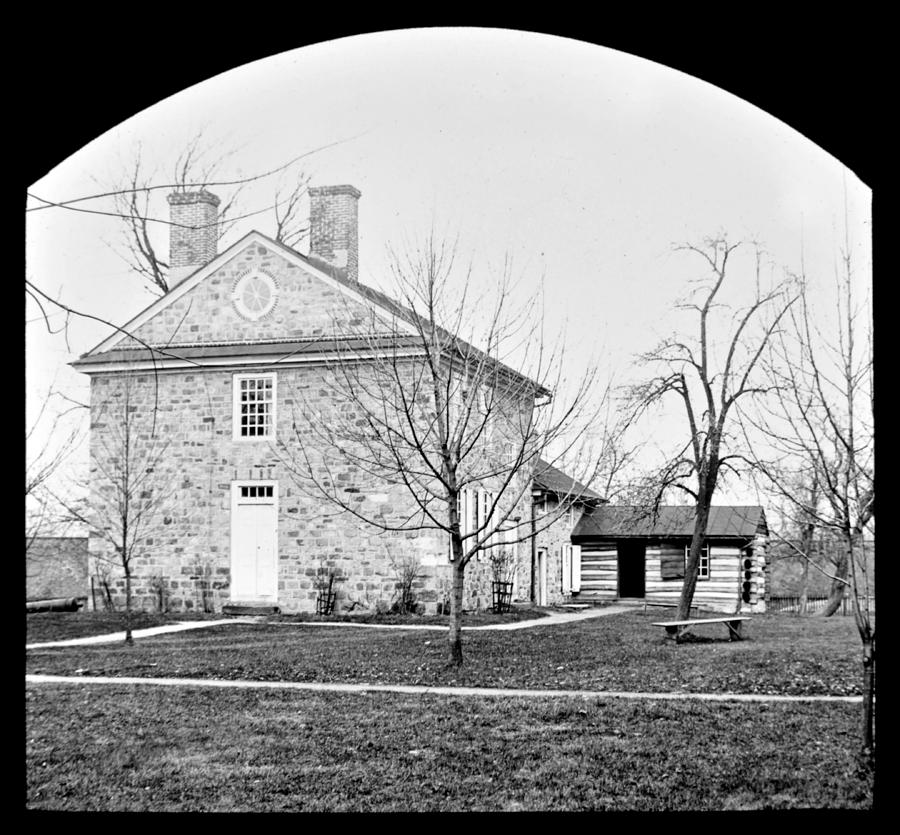
Having assumed the photo was taken somewhere in Chadds Ford, I didn’t trust the title, but now I see that it was indeed taken at Valley Forge and - I’ll wager - later in the day on August 20, 1899. The setting is the rear or east side of the Isaac Potts House, better known as Washington’s Headquarters.

Here is a photo of that side of the house (via fineartamerica.com), taken around the same time, but in winter and from the opposite point of view. But note the leaning tree, the stonework and shutters, and the white path:


Here, too, is another shot taken on the west side of the house, but showing the clapboard building seen in the Pyle class photo. That building can also be seen on page 88 of this document.

But why do I think the two photos of Pyle’s class were taken the same day? Because - as indicated in the papers of Schoonover and Day - it was the only journey to Valley Forge taken by the entire class in the summer of 1899. Plus, although folks didn’t change their clothes all that frequently in those days, there are many similarities in the outfits seen in both shots.

By the way, among other work being done by Pyle’s students at this time, Frank Schoonover was making his very first book illustrations for A Jersey Boy in the Revolution by Everett T. Tomlinson, published later that year by Houghton, Mifflin & Co. In fact, that same week, Schoonover - who had turned 22 the day before the Valley Forge trip - was painting the picture seen here, “A ball had crashed through the side.” It was the second of the set of four and his letters indicate that Pyle himself added a few brushstrokes - or more - to it.


Of course, Valley Forge was not unfamiliar territory for Howard Pyle: his earliest known visit was in 1879, when he was illustrating “Some Pennsylvania Nooks” by Ella Rodman Church for Harper’s New Monthly Magazine (April 1880), and perhaps he went again in 1896 for his picture of George Washington and General Steuben, or when painting “My dear,” said General Washington, “Captain Prescott’s behavior was inexcusable” for “Love at Valley Forge” (The Ladies’ Home Journal, December 1896); and he had also visited earlier that summer of 1899 (on July 9, with Arthurs, Hoyt, and McConnell - perhaps on a test run). Some ten years later, he returned again with his wife, son Godfrey, and a few friends and left “his mark” in the Washington Memorial Chapel guestbook.

And not long after Pyle’s death, a few of his historical artifacts wound up there, too: according to the 1912 Historical and Topographical Guide to Valley Forge by William Herbert Burk, “The most recent acquisitions are from the Howard Pyle collection - original uniforms and costumes used by the artist in his studies of Colonial life.”

Tuesday, August 19, 2014

Howard Pyle Filled Out His Son’s Birth Record

Howard Pyle’s third child, Theodore Pyle, was born 125 years ago today. His birth record (via Familysearch.org) was filled out by Pyle himself:

Friday, July 18, 2014

Teddy Roosevelt Checks In With Mrs. Pyle

If you scroll through the Theodore Roosevelt Papers at the Library of Congress, you’ll find this kindly letter to Howard Pyle’s widow - written one hundred years ago today:
SAGAMORE HILL

Oyster Bay, N.Y., July 18, 1914.

My dear Mrs. Pyle:

Mrs. Roosevelt wrote you some time ago and had no answer. I am writing you now merely to find out how you are and how you are getting along. You know how I valued your husband, and I do wish to know a little bit how life is going with you.

Faithfully yours,

Theodore Roosevelt

Mrs. Howard Pyle,
Wilmington, Del.
When I went a-scrolling myself a long while back, I was unable to find a copy of Mrs. Roosevelt’s letter, or one Mrs. Pyle may or may not have sent in reply to this one. But I like the idea of the former president remembering his friend - and reaching out to his widow - that summer day.

Saturday, May 17, 2014

Howard Pyle’s Werewolf


“The Werewolf” by Howard Pyle in The Ladies’ Home Journal for March 1896

Werewolf? There wolf. (There - no, there, in the middle foreground of the picture - just squint a little and you’ll see it.)

Yes, who knew that Howard Pyle had painted one? But so he did, to illustrate “The Werewolf” by the Chicago poet and humorist Eugene Field, who perhaps is best remembered for “Wynken, Blynken and Nod” and “The Duel” (also known as “The Gingham Dog and the Calico Cat”).

Pyle met Field at least once, at a dinner honoring Thomas Bailey Aldrich at The Aldine Club in New York on March 24, 1893, where the other guests included James Whitcomb Riley, Frank R. Stockton, Charles Dudley Warner, and William Dean Howells - all of whom had made significant contributions to the “juvenile literature” of the period. Whether they had met before or after or regularly corresponded, I don’t yet know, but on November 3, 1895, Pyle inscribed a copy of his newly-published novel, The Garden Behind the Moon, “To Eugene Field, My fellow worker in the world of Art” and added (in his confusingly hifalutin way):
For as the spoken word is like a breath of wind that maybe stirs the world around to agitation that soon is still again, so is the written word like a stone of rock cut out from the bosom of humanity, to endure for generations and for ages.

And as a pebble cast into the sea shall cause a movement to be felt in the uttermost parts of the waters for ever, so shall our work, cast into the bosom of futurity cause its motive to be felt to the furthermost ebb and flood of Eternity.

How great then, O! brother, our endeavour for good and for truth.


Inscription from Howard Pyle to Eugene Field, November 3, 1895 (via Bonhams)

But Field never read this: the day after Pyle inscribed the book, Field suffered a fatal heart attack at the age of 45. Shocked, Pyle sent both the book and a letter “expressing his deep sympathies and fond memories” to the Field’s widow on November 10th. “That you appreciated his lofty aims[,] his nobility of thought[,] his humane efforts and the success that crowned them is shown in your words,” wrote Mrs. Field later that month, and she assured Pyle “of a lasting place in my thoughts for Gene’s sake” and called The Garden Behind the Moon “a story after my own heart.”

Then came “The Werewolf.” According to a syndicated news item, Field had been writing and rewriting the story since 1884:
His last revision pleased him and he decided to print it. But death came too suddenly, and the story was found, unpublished, among his effects. Mrs. Field, concluding to have the story appear, gave it to the editor of The Ladies Home Journal, in which magazine all of Mr. Field’s work, outside of his newspaper articles, was presented to the public.
And of course it needed to be illustrated. An article in the January 3, 1943, edition of The Sunday Morning Star of Wilmington, Delaware, quoted “a Wilmington man” who had been an associate editor of the The Ladies’ Home Journal and who recalled his 1895 visit to Pyle:
It is remembered that Mr. Pyle’s working quarters were crowded with costumes, guns and ships of the Revolutionary era. I was advised that Mr. Pyle was always busy, and it was a difficult assignment for the youthful editor of a magazine. However, the artist consented to make the picture after learning that it was to illustrate the last literary work of the Chicago poet and humorist. Mr. Pyle admitted that he was an admirer of Field, and inasmuch as the story suggested just the type of drawing that he had been anxious to make he accepted the commission and was authorized to write his own check.

The illustration was for “The Werewolf” and it was believed that it represented the best work of Mr. Pyle as well as the best story by the author of “Little Boy Blue,” and it was so regarded by admirers of both artistic and author. The illustration was lauded greatly, for Mr. Pyle had drawn the ghost of a snarling wolf, fitting the text admirably.
The fee is not known, but it included publication rights and “The Werewolf” painting itself. And Pyle must have painted it sometime between mid- or late November 1895 and January 1896, since by February it was on display in Chicago in a travelling exhibition of illustrations made for the Journal. In a review of the show, the Inter Ocean of Sunday, February 1, 1896, called Pyle’s painting “a weird, uncanny-looking thing, possessing strange fascination.” The next day, the same paper noted:
In this work Mr. Pyle experimented using red and black oils on canvas. The result is something weird and fascinating. In the foreground is the fabled monster, the “were-wolf,” a horrible creature dimly outlined; in the background is a party of pleasure-seekers, terror-stricken, fleeing for their lives. The scene is laid in a dark and dreary wood.
That same day, the Chicago Tribune said:
A striking picture in oil by Howard Pyle to illustrate “The Werewolf,” an unpublished tale by Eugene Field, is the strongest thing in the collection. Indeed, it is said Pyle himself regards it as the best work he has ever done.
It was admired by other attendees of the exhibit as well, including members of Field’s family. On February 27, 1896, his sister-in-law Henrietta Dexter Field wrote Pyle “to express the admiration and deep appreciation both my husband, Roswell Field, and myself have for the beautiful illustration you designed for ‘The Werewolf’”:
We saw the painting at “The Ladies Home Journal” exhibition of pictures here and were more than gratified that the public seemed to appreciate its beauties, as there were always crowds standing before it. If Eugene were here I feel sure that he would be more than pleased that you caught his idea so beautifully, and he doubtless would write you words of appreciation more suitable than these, whose only merit lies in the expression of the love of a sorrowing brother and sister.
The Chicago exhibition slightly pre-dated the publication of the picture in The Ladies’ Home Journal for March 1896, where - in a halftone plate engraved by Albert Munford Lindsay (who, I might add, attended some of Pyle’s illustration classes at the Drexel Institute and visited Pyle at his home at about this time) - it was wordily titled, “The werewolf skulked for a moment in the shadow of the yews, and Yseult plucked old Siegfried’s spear from her girdle.” Echoing the Inter Ocean, The New York Times of March 11, 1896, called it “a weird drawing...that is mystic and suggestive while thoroughly original.”

And, indeed, Pyle liked it enough to borrow it back from the publisher for his one-man shows at the Drexel Institute in Philadelphia and the St. Botolph Club in Boston in 1897. The following year it was exhibited in Washington, D.C. - and perhaps elsewhere - again under the auspices of the The Ladies’ Home Journal. The Curtis Publishing Company (publisher of Journal) also issued it as a 12 x 15" print around the same time.

But then a fog rolls into the painting’s history: the anonymous associate editor quoted above also said, “It was long carefully displayed in the editor’s office” - and I assume, here, he was referring to editor-in-chief Edward W. Bok - “but [then it] mysteriously disappeared, and all attempts to relocate it have failed.”

Somehow, however, it wound up in the possession of Charles William Hargens, Jr. (1893-1997) and his wife Marjorie Allen (Garman) Hargens (1895-1978), illustrators both, who lived for many years in Bucks County, Pennsylvania. And then it went to their son, engineer Charles William Hargens III (1918-2013), and then to his estate.

And now it’s for sale: Freeman’s will auction the painting in Philadelphia on June 8, 2014. The estimate is $8,000-12,000. I consider that to be conservative, considering its size - 18 x 24 inches - and relative importance - but we’ll soon find out!


“The Werewolf” by Howard Pyle (via Freeman’s)

Thursday, May 8, 2014

Howard Pyle and Arthur Conan Doyle, Part 1


My interest in Howard Pyle owes a lot to my interest in Arthur Conan Doyle. When I was 11 or 12, I became obsessed with Sherlock Holmes and soon began collecting everything I could find - and afford - that had even the slightest mention of either the character or his creator (and of course by “creator” I mean “Dr. Watson’s Literary Agent”).

A few years in, I bought a bound volume of Harper’s Monthly from 1893 because it contained the serialization of Conan Doyle’s The Refugees with illustrations by Thure de Thulstrup. Although I didn’t read the novel nor did I find de Thulstrup’s illustrations that intriguing, I was drawn to - and kept revisiting - some other pictures in the book and I wanted to find more pictures and to learn more about their maker, Howard Pyle. So I did, and near my Sherlock Holmes-Conan Doyle shelves a little “Pyle pile” started to form.

Some of my initial Pyle purchases were “crossover” items like that bound Harper’s Monthly, or Collier’s cheap editions of The Green Flag, or the only two Conan Doyle pieces ever illustrated by Pyle - the novella The Parasite and the poem “A Forgotten Tale” - but, before long, my Pyle obsession had superseded all others.

Still, I’ve never completely shaken my initial addiction, and I often wonder what Howard Pyle’s illustrations for the Sherlock Holmes stories - or for Conan Doyle’s historical fiction - would have been like. I also wonder if the two ever met or corresponded: after all, the publication of Pyle’s Conan Doyle illustrations coincided with the latter’s visit to America in the fall of 1894, where he met a number of people Pyle knew. But, so far, I’ve come up with nothing.

Shown here is one of Pyle’s four illustrations for The Parasite, which was serialized in Harper’s Weekly. This piece - “‘Austin,’ she said, ‘I have come to tell you our engagement is at an end’” - appeared in the November 10, 1894, issue and the 10.2 x 8.4" halftone engraving was by William Kurtz. I think it hints bittersweetly at what could have been, if only Harper & Brothers had picked Pyle instead of (meh!) William Henry Hyde to illustrate the miscellaneous Sherlock Holmes tales published in the Weekly in 1893.

Thursday, May 1, 2014

Howard Pyle Meets With John Sloan, May 1, 1906

According to his diary, John Sloan met Howard Pyle on this day in 1906. Sloan, then, was making his living as an illustrator, but also painting and etching like mad on the side. Howard Pyle, meanwhile, was enduring an odd stint in his life as the Art Editor of McClure’s Magazine, located at 44 East 23rd Street in New York City. (Incidentally, another probable occupant of the offices that same day was Willa Cather, who had recently joined the magazine’s staff and who had also recently presented Pyle with a copy of her book The Troll Garden.) After meeting with Pyle, Sloan wrote:
Made my first call on Howard Pyle, who is now Art Editor of McClure’s Magazine. Showed him my proofs, illustrations, etc. He treated me with courtesy. Said my work was good in “character” but just at present, you know - everything - not giving out much work - supplied ahead, etc., etc. Call again.
The two men may have met before, perhaps during one art function or another in Philadelphia in the 1890s, though this is the only documented encounter I’ve been able to locate. And Sloan’s sister Marianna is rumored to have been one of Pyle’s students (at least according to the Syracuse Post-Standard of February 14, 1904). Even so, Sloan didn’t sound very encouraged. Two weeks after that meeting - and in the wake of a crisis at the McClure offices - Sloan noted that, despite the exodus of a large chunk of the staff, including muckraking superstars Lincoln Steffens and Ida Tarbell: “H. Pyle remains, I fear. Little chance for my work under the ‘boilermaker.’”

Ouch. Was Sloan reflecting on the steady stream of illustrators from Pyle’s “big art manufactory [sic]” (as Pyle student George Harding referred to it), who virtually flooded the market with what some artists no doubt deemed a clichéd way of making pictures? Maybe so.

The magazine did, however, publish a story, “The Debts of Antoine” by W. B. MacHarg, with Sloan’s pictures - dated ’06 - in the December 1906 issue. Whether Pyle commissioned these or not, I don’t yet know, but Sloan considered it “joyful news” when Pyle resigned from McClure’s that August.

Wednesday, March 19, 2014

Some “Occasional Comics” by Howard Pyle

“I used to earn a little odd money by drawing an occasional comic,” wrote Howard Pyle in his scrapbook about some of the work he did when he first moved to New York in the fall of 1876. “The Night Watch” (above) was one such drawing, published as “Family Cares” in Scribner’s Monthly for April 1877. “Bliss” (below) was another, which appeared in the same magazine the following month.

From Pyle’s letters home, we know that he drew these two in November 1876. Another picture - so stylistically close to these that Pyle most likely made it at about the same time - was printed in the July 1877 issue of Scribner’s Monthly with the vague title, “A Quotation from ‘King Lear’”.

The original pen-and-ink was, I thought, last heard of when it was sold at auction by Scott & O’Shaughnessy in New York City on April 27, 1916. But, in poking around online, I came across it, semi-misidentified - but viewable here in a nice, high-resolution scan - in the collection of the Folger Shakespeare Library in Washington, DC.

Along the side of the drawing we see - in Pyle’s handwriting - what was probably his intended caption: “‘Take physic, pomp (Pomp)’ (King Lear: Act III: Scene IV.” I can’t explain the double “pomp” or why the caption wasn’t printed. Perhaps Scribner’s Monthly’s editors - either Josiah Gilbert Holland, Richard Watson Gilder, or Robert Underwood Johnson - assumed their magazine’s readers were versed well enough in Shakespeare to get the “joke” without the quotation itself. I, for one, am pretty thick-witted, so I can’t gauge how funny it is - or if it’s funny at all. And when it comes to his Shakespeare-themed pictures, it’s sort of a shame that Pyle - who loved Shakespeare’s works and times and long-wished to illustrate the Sonnets, but never did - left only this crude, stereotype-ridden “comic” behind.

The extended quote, by the way, is from Lear himself and goes:
Poor naked wretches, whereso’er you are,
That bide the pelting of this pitiless storm,
How shall your houseless heads and unfed sides,
Your loop’d and window’d raggedness, defend you
From seasons such as these? O, I have ta’en
Too little care of this! Take physic, pomp;
Expose thyself to feel what wretches feel,
That thou mayst shake the superflux to them,
And show the heavens more just.

Howard Pyle and Teddy Roosevelt Do Lunch Revamped

I revamped a post I wrote four years ago about Theodore Roosevelt’s day 110 years ago today - which included lunch with Howard Pyle. I even added some pictures.

Monday, March 17, 2014

The Queen of Ireland seeks to slay Sir Tristram

A semi-desperate attempt on my part to post something “Irish” on this St. Patrick’s Day: “The Queen of Ireland seeks to slay Sir Tristram” comes from Howard Pyle’s second volume of his Arthuriad, The Story of the Champions of the Round Table, published by Charles Scribner’s Sons in 1905.

As far as I know, the original pen-and-ink has yet to surface on the market or in a museum. It’s an interesting composition and it takes some staring at to make sense of what’s going on. Or one could simply read the passage it illustrates:
Now whilst Sir Tristram was in that bath, the Queen [of Ireland] and Belle Isoult looked all about his chamber. And they beheld the sword of Sir Tristram where it lay, for he had laid it upon the bed when he had unlatched the belt to make himself ready for that bath. Then the Queen said to the Lady Belle Isoult, “See what a great huge sword this is,” and thereupon she lifted it and drew the blade out of its sheath, and she beheld what a fair, bright, glistering sword it was. Then in a little she saw where, within about a foot and a half from the point, there was a great piece in the shape of a half-moon broken out of the edge of the sword; and she looked at that place for a long while. Then of a sudden she felt a great terror, for she remembered how even such a piece of sword as that which had been broken off from that blade, she had found in the wound of Sir Marhaus of which he had died. So she stood for a while holding that sword of Sir Tristram in her hand and looking as she had been turned into stone. At this the Lady Belle Isoult was filled with a sort of fear, wherefore she said, “Lady, what ails you?” The Queen said, “Nothing that matters,” and therewith she laid aside the sword of Sir Tristram and went very quickly to her own chamber. There she opened her cabinet and took thence the piece of sword-blade which she had drawn from the wound of Sir Marhaus, and which she had kept ever since. With this she hurried back to the chamber of Sir Tristram, and fitted that piece of the blade to the blade; and lo! it fitted exactly, and without flaw.

Upon that the Queen was seized as with a sudden madness; for she shrieked out in a very loud voice, “Traitor! Traitor! Traitor!” saying that word three times. Therewith she snatched up the sword of Sir Tristram and she ran with great fury into the room where he lay in his bath. And she beheld him where he was there all naked in his bath, and therewith she rushed at him and lashed at him with his sword. But Sir Tristram threw himself to one side and so that blow failed of its purpose. Then the Queen would have lashed at him again or have thrust him through with the weapon; but at that Gouvernail and Sir Helles ran to her and catched her and held her back, struggling and screaming very violently. So they took the sword away from her out of her hands, and all the while she shrieked like one gone entirely distracted.
Happy St. Patrick’s Day!